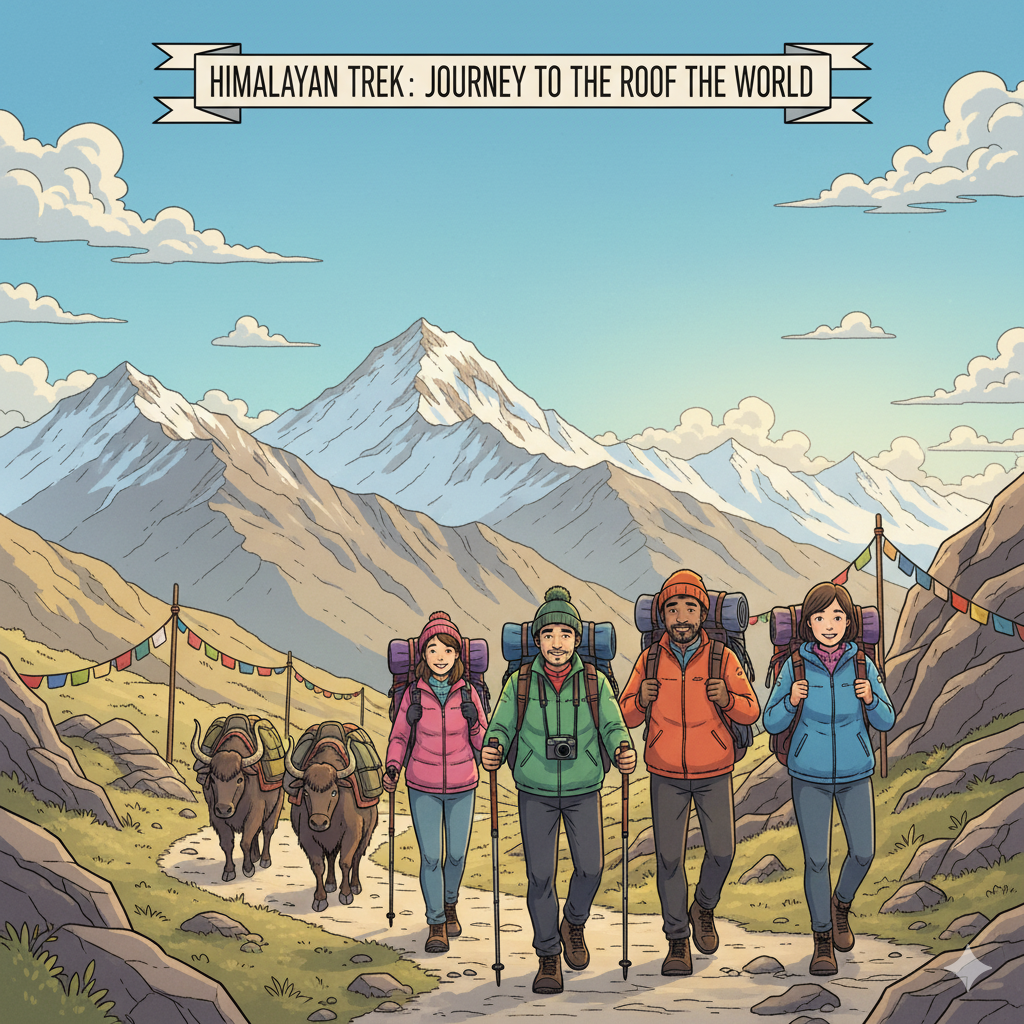
Himalaya Porters
1. I once went trekking in the Himalayas.
저는 히말라야에 트레킹을 간 적이 있습니다.
● go trekking: 트레킹을 가다
- I once went trekking in the Himalayas.
(저는 히말라야에 트레킹을 간 적이 있습니다.)
- We plan to go trekking in Nepal next year.
(우리는 내년에 네팔로 트레킹을 갈 계획입니다.)
- They went trekking across the Andes Mountains.
(그들은 안데스산맥을 따라 트레킹을 했습니다.)
⸻
2. No matter how much I tried to pack light, it was impossible to carry everything myself for such a long trip.
그런데 짐을 아무리 줄여도 오랜 일정 내내 전부 직접지고 다니기는 사실상 어려웠습니다.
● pack light: 짐을 가볍게 싸다
- No matter how much I tried to pack light, it was impossible to carry everything myself.
(짐을 아무리 줄여도 전부 직접 지고 다니기는 사실상 어려웠습니다.)
- I prefer to pack light, but my husband brings everything.
(나는 짐을 가볍게 싸는 게 좋지만, 남편은 전부 다 챙긴다.)
- It’s a lot more convenient to pack light.
(짐을 가볍게 싸면 훨씬 편하다.)
● no matter how much: 얼마나 ~하더라도
- No matter how much I studied, I couldn’t pass the exam.
(아무리 공부해도 시험을 통과할 수 없었습니다.)
- No matter how much he eats, he never gains weight.
(그는 아무리 먹어도 살이 찌지 않습니다.)
● carry everything myself: 모든 짐을 직접 들다
- I couldn’t carry everything myself, so I asked for help.
(모든 짐을 직접 들 수 없어서 도움을 청했습니다.)
⸻
3. So, through a local travel agency, I hired a porter who could carry my bag and guide me along the way.
그래서 현지 여행사를 통해서, 짐을 들어 주고 이동하는 동안 안내를 해 줄 수 있는 짐꾼을 고용했습니다.
● through a local travel agency: 현지 여행사를 통해
- We booked our tour through a local travel agency.
(우리는 현지 여행사를 통해 투어를 예약했습니다.)
● hire a porter: 짐꾼을 고용하다
- We decided to hire a porter for the mountain trek.
(우리는 산 트레킹을 위해 짐꾼을 고용하기로 했습니다.)
● along the way: 길을 따라, 도중에
- We stopped for snacks along the way.
(가는 길에 간식을 먹기 위해 멈췄습니다.)
- I met many kind people along the way.
(가는 도중에 많은 친절한 사람들을 만났습니다.)
⸻
4. The porter I hired not only carried my load but also helped me with directions.
제가 고용한 짐꾼은 짐도 들어 주고 길 안내도 해 주었습니다.
● not only A but also B: A뿐만 아니라 B도
- The porter not only carried my load but also helped with directions.
(그 짐꾼은 짐뿐 아니라 길 안내도 도와주었습니다.)
- She is not only smart but also very kind.
(그녀는 똑똑할 뿐 아니라 매우 친절합니다.)
⸻
5. We were able to communicate with just a handful of English words.
우리는 영어 단어 몇 개 정도로도 의사소통이 가능했습니다.
● with just a handful of: 적은 양의 ~만으로
- We were able to communicate with just a handful of English words.
(우리는 영어 단어 몇 개 정도로도 의사소통이 가능했습니다.)
- I made the slides with just a handful of images.
(나는 몇 개의 이미지만 가지고 슬라이드를 작성했다.)
- I returned with just a handful of souvenirs.
(나는 몇 개의 기념품만 가지고 돌아왔다.)
● be able to + 동사원형: ~할 수 있다
- I was able to finish the work on time.
(나는 제시간에 일을 끝낼 수 있었습니다.)
⸻
6. I was glad that I could ask questions while we were trekking.
트레킹을 하면서 궁금한 부분도 물어볼 수 있어서 매우 좋았습니다.
● be glad that ~ : ~해서 기쁘다
- I was glad that I could ask questions.
(질문할 수 있어서 기뻤습니다.)
- I’m glad that you came.
(당신이 와서 기쁩니다.)
● while + 주어 + 동사: ~하는 동안
- I listened to music while cooking.
(나는 요리하는 동안 음악을 들었다.)
⸻
7. Porters usually stay at the same lodges as the people who hire them. They are provided with meals and amenities.
짐꾼들은 보통 고용한 사람과 같은 숙소에 묵으면서 식사와 편의를 제공받습니다.
● stay at a lodge: 숙소에 머물다
- We stayed at a cozy lodge near the mountains.
(우리는 산 근처의 아늑한 숙소에 머물렀습니다.)
● be provided with: ~을 제공받다
- Employees are provided with free meals.
(직원들은 무료 식사를 제공받습니다.)
● amenities: 편의시설, 편의물품
- The hotel offers modern amenities.
(그 호텔은 현대적인 편의시설을 제공합니다.)
⸻
8. Since you spend a lot of time together during the trip, it’s natural to grow close.
여행 내내 많은 시간을 함께 보내다 보니 자연스럽게 가까워지게 됩니다.
● spend a lot of time together: 많은 시간을 함께 보내다
- Since you spend a lot of time together during the trip, it’s natural to grow close.
(여행 내내 많은 시간을 함께 보내다 보니 자연스럽게 가까워지게 됩니다.)
- We don’t get to spend a lot of time together these days.
(우리는 요즘 함께 시간을 많이 보내지 못하고 있다.)
- They spent a lot of time together when they first started dating.
(그들은 처음 사귀기 시작했을 때 많은 시간을 함께 보냈다.)
● grow close: 가까워지다
- They grew close after spending the summer together.
(그들은 여름을 함께 보내며 가까워졌다.)
⸻
9. The conversations I had with my porter have stayed with me as fond memories.
그분과 여러 가지 이야기를 나누었던 것이 좋은 추억으로 남았습니다.
● stay with someone: (기억·인상 등이) 마음에 남다
- Her words stayed with me for a long time.
(그녀의 말이 오랫동안 내 마음에 남았다.)
● fond memories: 좋은 추억
- I have fond memories of my childhood.
(나는 어린 시절의 좋은 추억이 있습니다)
<Dialogue Practice>
A: You mentioned you went trekking in the Himalayas, right?
B: Yes, that's right. I went at the end of last year.
A: Wasn't it hard? How did you get through it?
B: I hired a porter who carried my bag and guided me along the way.
A: Oh, I see.
B: The conversations we had have stayed with me as fond memories.
A: 히말라야 트레킹 다녀오셨다고 했죠?
B: 네, 맞아요. 작년 말에 갔다 왔어요
A: 힘들진 않으셨어요? 어떻게 해내셨어요?
B: 짐을 들어주고 안내도 해 주는 짐꾼을 고용했어요
A: 아, 그렇군요
B: 그분과 나눈 이야기들이 좋은 추억으로 남았어요.
출처 : 입트영 11월호
'영어공부' 카테고리의 다른 글
| 25.11.07 When No Answer Appears (0) | 2025.11.06 |
|---|---|
| 25.11.07 The Best Countries to Retire Abroad in 2025 (0) | 2025.11.06 |
| 25.11.06 How Space Powerhouse SpaceX Transformed Spaceflight (0) | 2025.11.05 |
| 25.11.05 Tesla Proposes Enormous New Pay Package to Retain Elon Musk (0) | 2025.11.04 |
| 25.11.05 Instant Coffee Mix (0) | 2025.11.04 |


