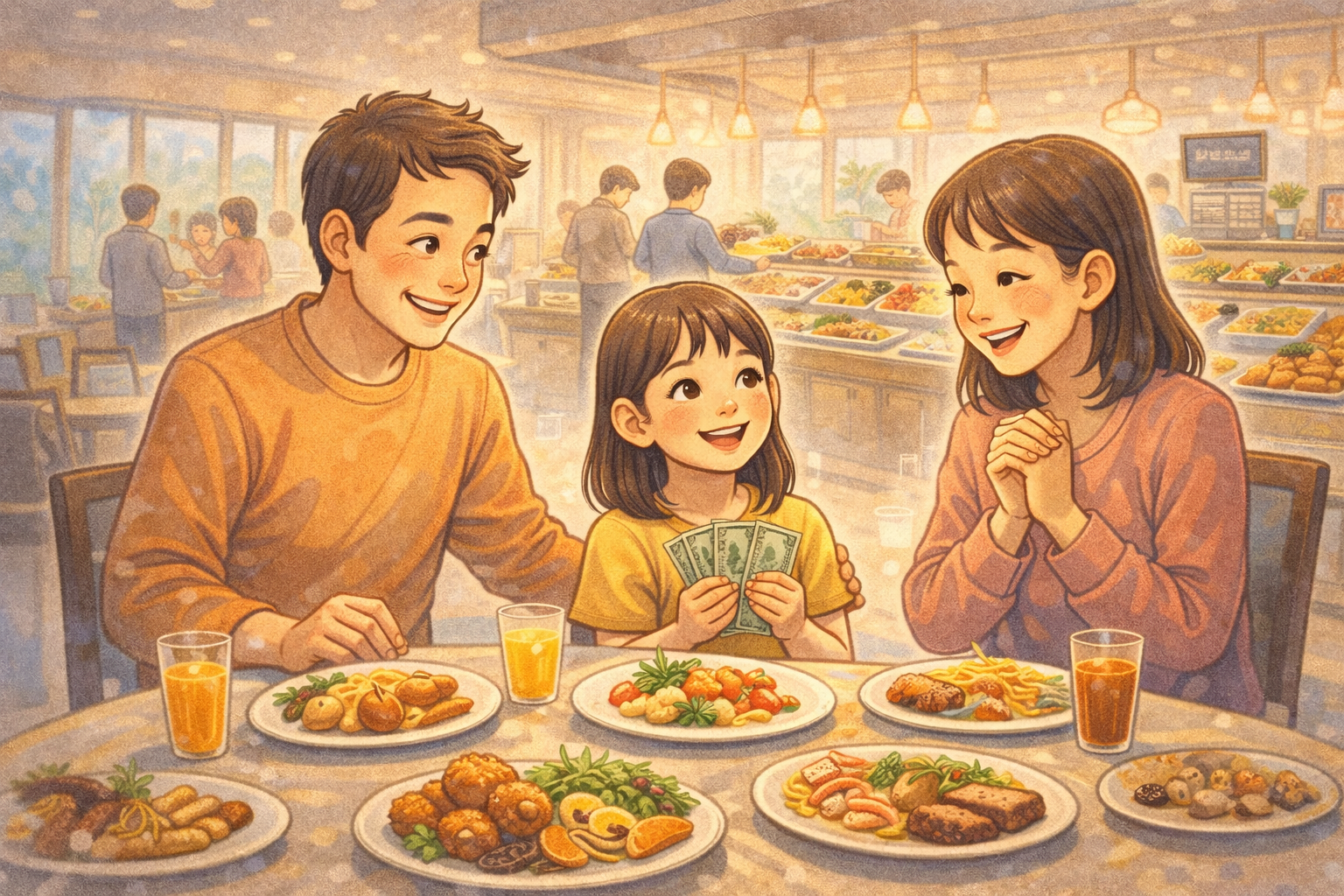
Daughter's Gift
1. I’m an ordinary dad with a daughter in fourth grade.
저는 초등학교 4학년 딸을 가진 평범한 아빠입니다.
● ordinary dad: 평범한 아빠
• He describes himself as an ordinary dad.
(그는 자신을 평범한 아빠라고 묘사한다.)
⸻
2. A couple of days ago, it was Parents’ Day.
며칠 전이 어버이날이었습니다.
● Parents’ Day: 어버이날
• We celebrated Parents’ Day together.
(우리는 함께 어버이날을 기념했다.)
⸻
3. Since it fell on a weekday, we didn’t get a chance to eat out as a family.
그날은 평일이어서 가족끼리 외식을 할 기회가 없었습니다.
● eat out as a family: 가족끼리 외식하다
• We rarely eat out as a family on weekdays.
(우리는 평일에는 가족 외식을 거의 하지 않는다.)
⸻
4. That weekend, my daughter suggested we go to a family restaurant buffet, and she said that she would cover the bill.
그런데 저희 딸이 그 주말에 자기가 돈을 낼 테니, 패밀리 레스토랑에 가서 뷔페를 먹자고 제안했습니다.
● cover the bill: 비용을 부담하다
• She said that she would cover the bill.
(그녀는 자기가 돈을 내겠다고 했다.)
• I can cover the bill this time.
(이번에는 내가 낼게.)
• The loser has to cover the bill.
(지는 사람이 비용을 부담해야 한다.)
⸻
5. So, our family went out to a buffet that weekend.
그래서 우리 가족은 그 주말에 뷔페에 갔습니다.
● go out to ~: ~에 가다(외식·외출)
• We went out to a buffet together.
(우리는 함께 뷔페에 갔다.)
⸻
6. We had an amazing time thanks to our daughter.
딸 덕분에 정말 멋진 시간을 보냈습니다.
● have an amazing time: 멋진 시간을 보내다
• We had an amazing time together.
(우리는 함께 멋진 시간을 보냈다.)
⸻
7. We enjoyed great food and chatted about this and that at a fancy restaurant.
고급진 레스토랑에서 맛있는 식사를 하며 이런저런 이야기를 나눴습니다.
● chat about this and that: 이런저런 이야기를 나누다
• We chatted about this and that over dinner.
(우리는 저녁을 먹으며 이런저런 이야기를 나눴다.)
⸻
8. She had saved up her allowance little by little to pay for the meal.
아이는 그동안 용돈으로 받은 돈을 조금씩 모아서 음식값을 냈습니다.
● save up one’s allowance: 용돈을 모으다
• She had saved up her allowance little by little.
(그녀는 용돈을 조금씩 모아 왔다.)
• I saved up my allowance to buy a new phone.
(나는 새 휴대폰을 사려고 용돈을 모았다.)
• My son saved up his allowance for three months.
(아들은 3개월 동안 용돈을 모았다.)
⸻
9. I was so proud of her.
딸아이가 얼마나 기특했는지 모릅니다.
● be proud of ~: ~을 자랑스럽게 여기다
• I was so proud of my daughter.
(나는 딸이 정말 자랑스러웠다.)
⸻
10. When her birthday comes around, I will definitely treat her to a great meal.
딸 생일이 돌아오면 제가 꼭 맛있는 밥을 사 줄 생각입니다.
● treat someone to ~: ~에게 사 주다, 대접하다
• I will definitely treat her to a great meal.
(나는 그녀에게 꼭 맛있는 식사를 사 줄 것이다.)
• I’ll treat you to lunch next week.
(다음 주에 내가 점심 살게.)
• I treated my coworkers to coffee after the meeting.
(회의 후에 동료들에게 커피를 샀다.)
<Dialogue Practice>
A: It looks like you went to a fancy restaurant over the weekend!
B: Oh, so you must have seen the photos.
A: Yes, it looked like such a great time.
B: Our daughter is only in fourth grade, but she paid for the meal.
A: Oh, really?
B: She used her saved-up allowance to treat us because we couldn't go out on Parents' Day.
A: 주말에 멋진 음식점에 가서 식사를 하신 모양이던데요?
B: 아, 사진 보셨군요.
A: 네, 너무 좋아 보이던데요?
B: 이제 초등학교 4학년밖에 안 된 우리 딸이 밥값을 냈어요.
A: 어머, 정말이요?
B: 어버이날 같이 외식을 못했다며 모아 놓은 용돈으로 사주었어요.
출처 : 입트영 1월호
'영어공부' 카테고리의 다른 글
| 26.01.06 How I Started Working Out (1) | 2026.01.05 |
|---|---|
| 26.01.06 Musk's xAl Pursues Major Funding as Competition in Al Accelerates (0) | 2026.01.05 |
| 26.01.05 Elon Musk's Unusual Approach to Wealth and Spending (0) | 2026.01.04 |
| 26.01.02 Blood Sugar Levels (0) | 2026.01.01 |
| 26.01.02 Big Sky Tops the List of Rising Global Travel Destinations for 2026 (1) | 2026.01.01 |


